
WELLNESS TECH: A WHOOP TEARDOWN
How the band became a ritual, and what the category looks like when the lifestyle pivot hits.
Reading time
8 min
Published
BY
Veer Benepal

Tags
Wellness Tech, Wellness, Sensory Experiences, Design, Architecture, Neuroscience, Biology, Elegant Products
01
The hook
Will Ahmed was a Harvard squash captain who couldn't tell when he was peaking and when he was on the verge of burnout. Fourteen years later, 2.5M people pay him $200–360/year to answer that question every morning, his company is worth $10.1B, and the same brand that put a band on LeBron's wrist now needs to put one on the person sitting beside you. The question is whether it can do both.
02
The category, through this firm
We're all under-performing some version of ourselves we know is in there. Modern life sells the fix everywhere: sleep protocols, breathwork, zone 2 cardio, morning sunlight. But the delivery has been gutted. Advice arrives in thirty-second clips, each complicating the last, served by an algorithm whose entire job is to keep you scrolling instead of implementing. The act of consuming wellness has become the dopamine fix it was supposed to replace. You set out to fix your sleep and end up watching forty minutes of Huberman at 11pm in bed, undoing the exact thing you sat down to learn. Optimization without nervous-system regulation is a trap. That late-night scroll is itself allostatic load (McEwen, 2007) — chronic activation of the stress-response system, the exact dysregulated state every protocol is supposed to undo.
Modern work, modern light, modern food broke the calibration systems humans used to run on instinct. Wearable wellness tech exists because that calibration loop is broken. The category's job is to give people back the signal their body stopped sending freely — what neuroscientists call interoception, the perception of internal physiological state, which Craig (2002) identified as a distinct sensory system — so they can hear themselves again. The structural bet is that quantification creates ritual, and ritual creates retention. Every morning, the score. The day reorganizes around it. That shift from felt intuition to daily readout is a behavior change product, not a hardware product — which is why the winners here will be subscription businesses, not gadget makers.
03
What WHOOP is
WHOOP is a screenless wrist sensor and a recurring-revenue subscription that uses Photoplethysmography (PPG), a light-based technology, to measure blood flow, heart rate (HR), and heart rate variability (HRV). This signal collapses into three daily scores: Recovery, Strain and Sleep. The Recovery score is anchored to heart rate variability, the beat-to-beat variation in cardiac rhythm that reflects autonomic nervous system balance (Shaffer & Ginsberg, 2017). Founded by Will Ahmed in 2012, the company pivoted from a $500 upfront device to hardware-as-a-service in 2018, now charging $199–$359 a year across ONE, PEAK and LIFE tiers, with the device itself effectively free. As of today, there are 2.5M WHOOP members, $1.1B bookings run rate exiting 2025, 103% YoY growth, and the cash flow is positive for the first time. April 2026's Series G has priced the company at $10.1B, marking its last private round and a two-year IPO horizon as publicly stated by Will Ahmed.
04
The moat
The moat isn't the band. It's the corpus and the architecture underneath it. WHOOP has logged more than 500M nights of sleep and trillions of biometric data points across 14 years, almost all of it tied to longitudinal user identity rather than one-off snapshots. The corpus matters because heart rate variability, the anchor metric for Recovery, is highly individual. Meaningful HRV interpretation simply requires personal baselines built over weeks of continuous data, not population averages. The athlete community is what sharpens that corpus. LeBron, Patrick Mahomes, Rory McIlroy, and partnerships with the PGA, NFL Players Association, and now the Grand Slam tennis circuit aren't just endorsement deals. They serve as R&D and distribution at the same time. Elite athletes operate at the physiological extremes where measurement noise matters least and signal-to-noise ratios for HRV and recovery markers are at their cleanest, making them the strictest training set for the model. The third layer is ritual. Once an individual becomes a member and receives their score day-by-day, the retention solidifies. Checking the score becomes a behavioral primitive, which, like brushing teeth, is hard to dislodge once integrated. Habit research (Wood & Neal, 2007) shows that behaviors anchored to fixed daily contexts become automatic within weeks and resist disruption far longer than goal-driven behaviors — revealing 'ritual' to be the cheapest churn-suppressant in consumer subscription. The fourth layer, and the one most underpriced today, is WHOOP Coach. Powered by GPT-5.1 since late 2025, it uses a retrieval-augmented generation architecture, grounding responses in the user's own physiological corpus rather than generic LLM training data. This has driven a 22% DAU lift in beta. The data flywheel is now real: the corpus trains the model, the model deepens engagement, and engagement enriches the corpus.
Figure 1. WHOOP revenue composition, 2022–2026E. Subscription is 90% of the stack and growing. Advanced Labs is the next subscription expansion vector. Unite has been discontinued. Unit economics confirm a software-grade business under the hardware.
05
The tension nobody at HQ wants to say out loud
Plot every wearable wellness firm on a 2×2 of audience identity (from athlete-coded to lifestyle/wellness-coded) and data depth (single-signal hardware to integrated platform with clinical labs), and four of the six interesting players are racing toward the upper-right quadrant. Oura sits there now with 5.5M rings sold, $11B valuation on $1B revenue, peer-reviewed sleep accuracy ahead of WHOOP, and FDA filings for hormonal and clinical indications. Function Health sits there with $2.5B at the November 2025 Series B, 160+ biomarkers in a $365 membership, and the recent acquisition of Ezra for $499 full-body MRI. Eight Sleep is moving there with $1.5B March 2026, FDA filings for sleep apnea and menopause, and a billion hours of sleep data across 35 countries. Each one began with a different sensor or audience and is congregating to the same destination — an integrated wellness platform for high-functioning humans who pay for biological insight.
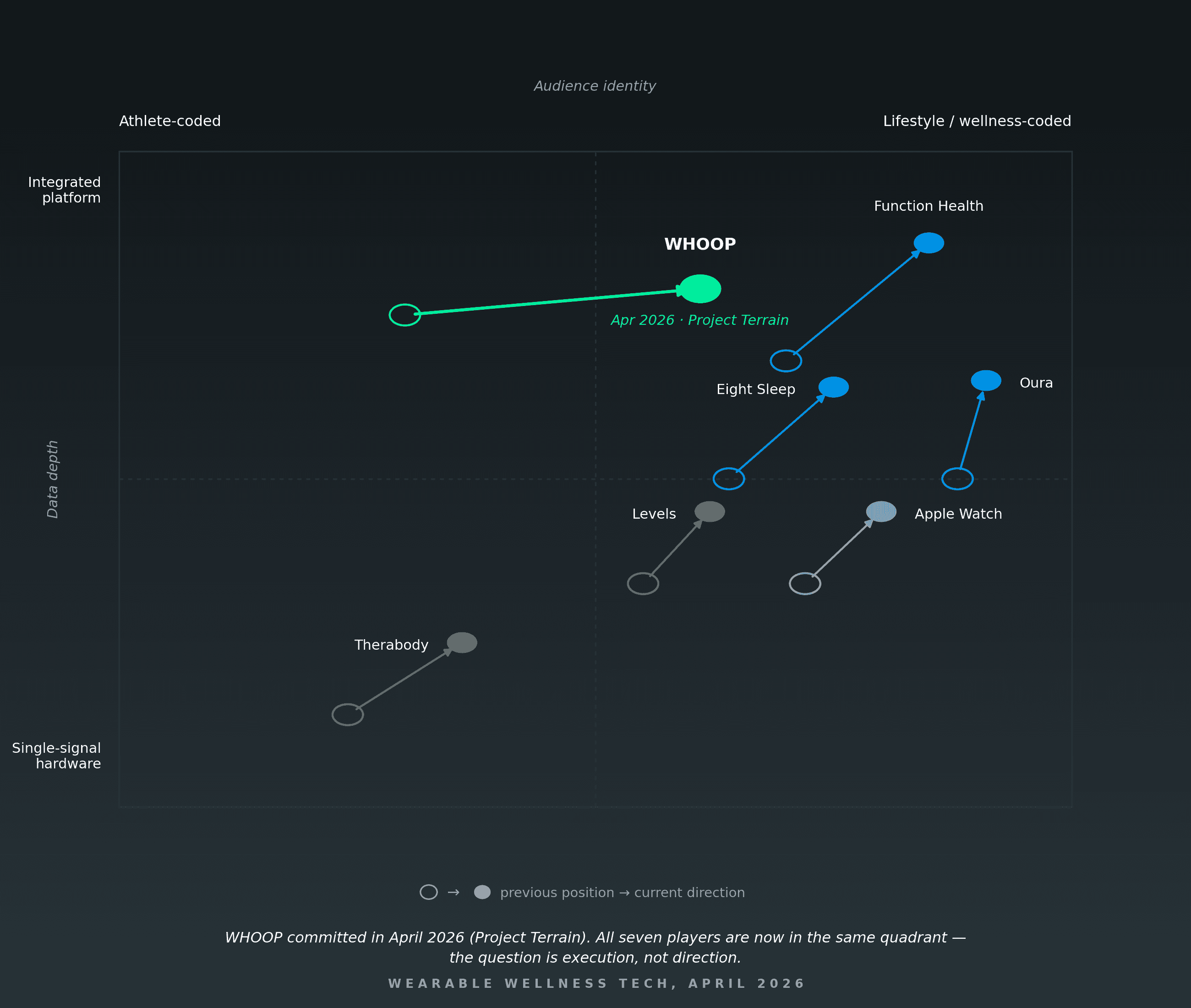
Figure 2. Wearable wellness category trajectories, April 2026. Each arrow shows where a player has moved over the past 24 months. WHOOP’s teal arrow lands inside the integrated-lifestyle quadrant via Project Terrain. The question now becomes execution, not direction.
WHOOP sits in the upper-left as an athlete-first brand and integrated platform underneath. However, the April 2026 product drop (LeatherLuxe leather bands, the WHOOP Body Any-Wear pod, Project Terrain collaboration with Samuel Ross MBE) has served to solve the form-factor problem cleanly and outline WHOOP's strategic intent explicitly. CEO Will Ahmed framed it as evolution “from a performance technology built for athletes into a true lifestyle brand,” and SVP Joel Lessard’s “24/7 wearability” framing names the diagnosis correctly. But form factor was the surface tension. The deeper one is brand identity, which is built from association, not material. A consumer can swap a polymer strap for leather and still read the device as training equipment, because what WHOOP means in the cultural imagination is downstream of LeBron, the PGA, the NFLPA, and the Grand Slam tennis approval secured the same week LeatherLuxe shipped (The National, 2026). Every public face of the company indexes elite athletic performance. The TechCrunch headline “Whoop has LeBron, now it wants your mom” (TechCrunch, 2026a) names exactly the gap, however heavy-handedly: WHOOP’s marketing equity sits inside the athlete archetype, while the next dollar of revenue has to come from people whose entry point is wellness, not performance. A leather band doesn’t bridge that.
The audience already names the next shape. Female membership grew 150% YoY in 2025 and women use Coach 30% more than men. The March 2026 Women’s Health Specialized Panel – 11 biomarkers, $299, run through Quest Diagnostics – is excellent product (TechCrunch, 2026b). Apparel grew 70% YoY (TechCrunch, 2026a). Each of these signals points the same direction: the WHOOP that’s actually growing is not the WHOOP only built for elite athletic performance. It’s the WHOOP people use to manage sleep, stress, recovery, and longevity – the lifestyle subscriber who came in for self-knowledge, not the next personal record. The product has pivoted to meet them, but the brand has ground to make up.
06
The move I’d make
Two different layers are addressed. What the brand signals to the world, and what the platform builds with its existing members.
The BIG Move: Sub-brand the lifestyle audience. Don’t dilute the master brand.
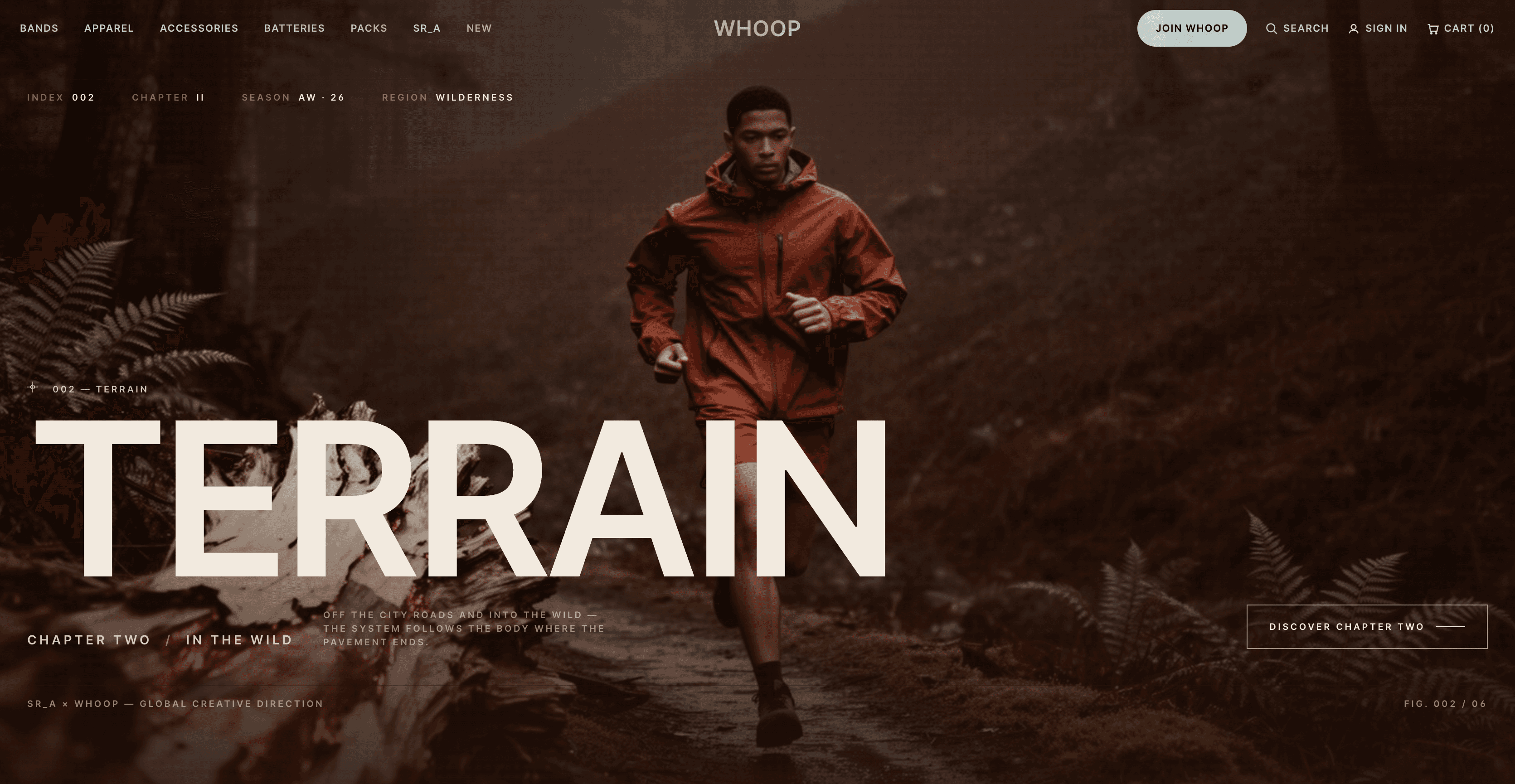
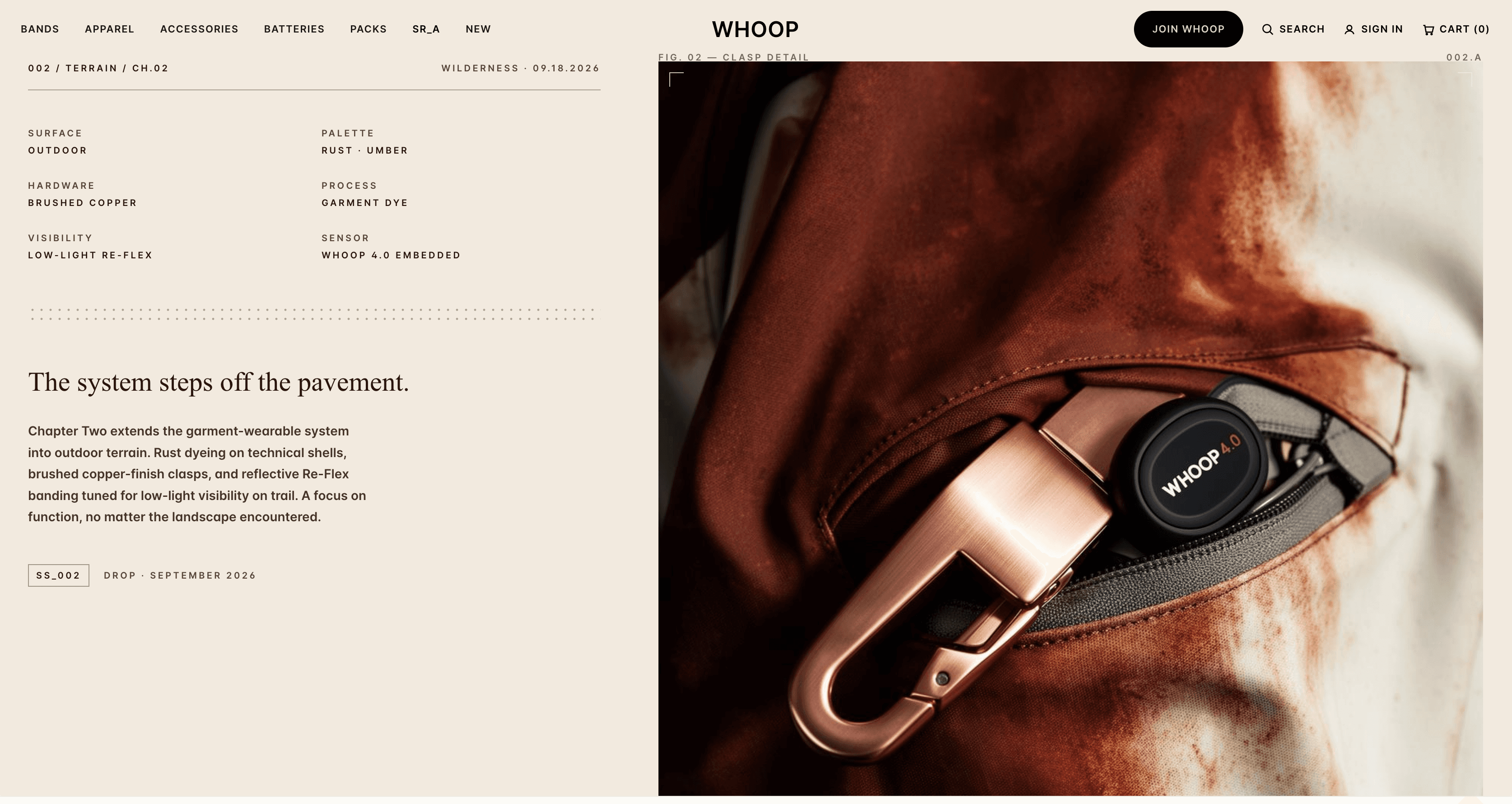
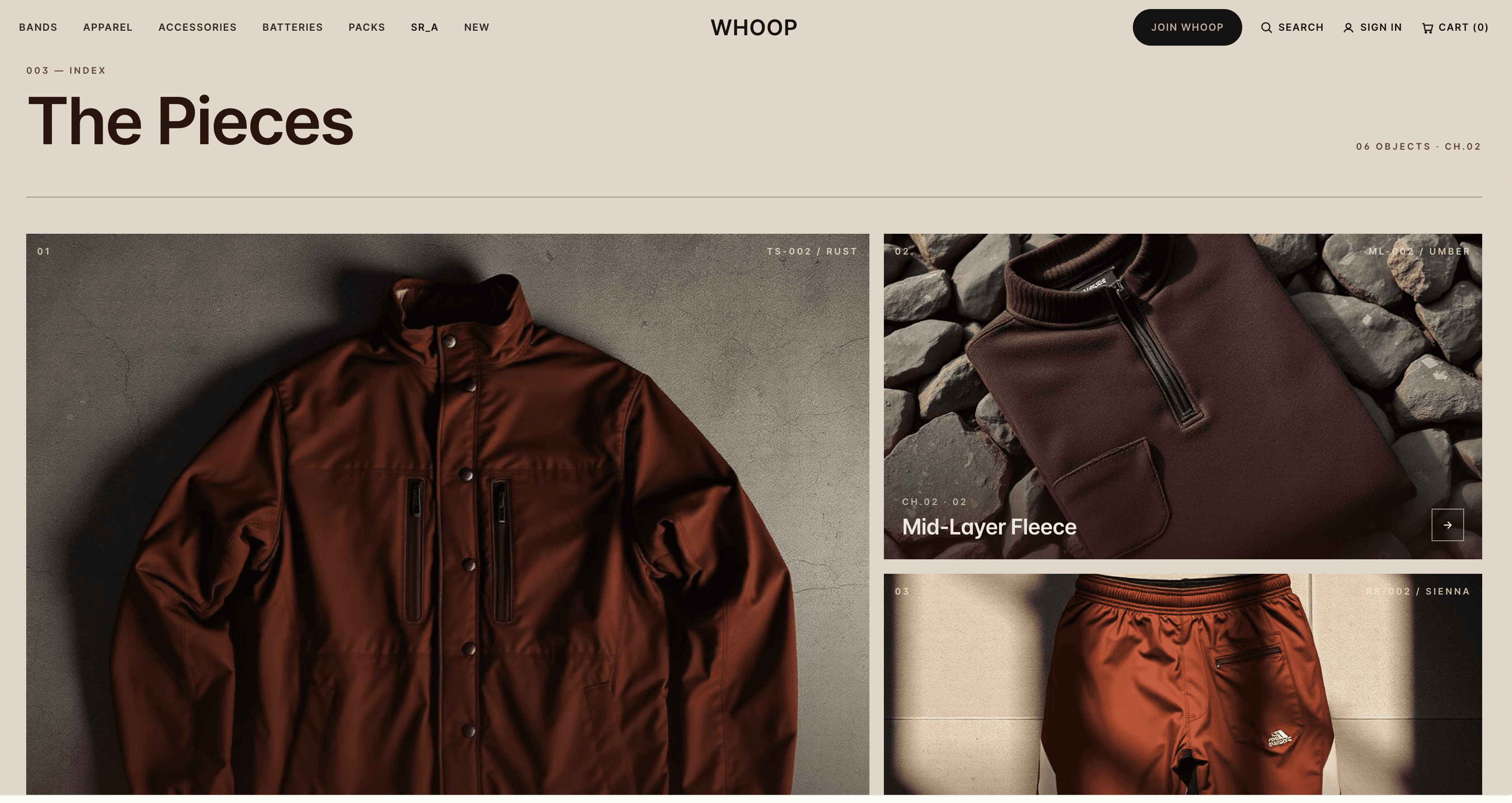
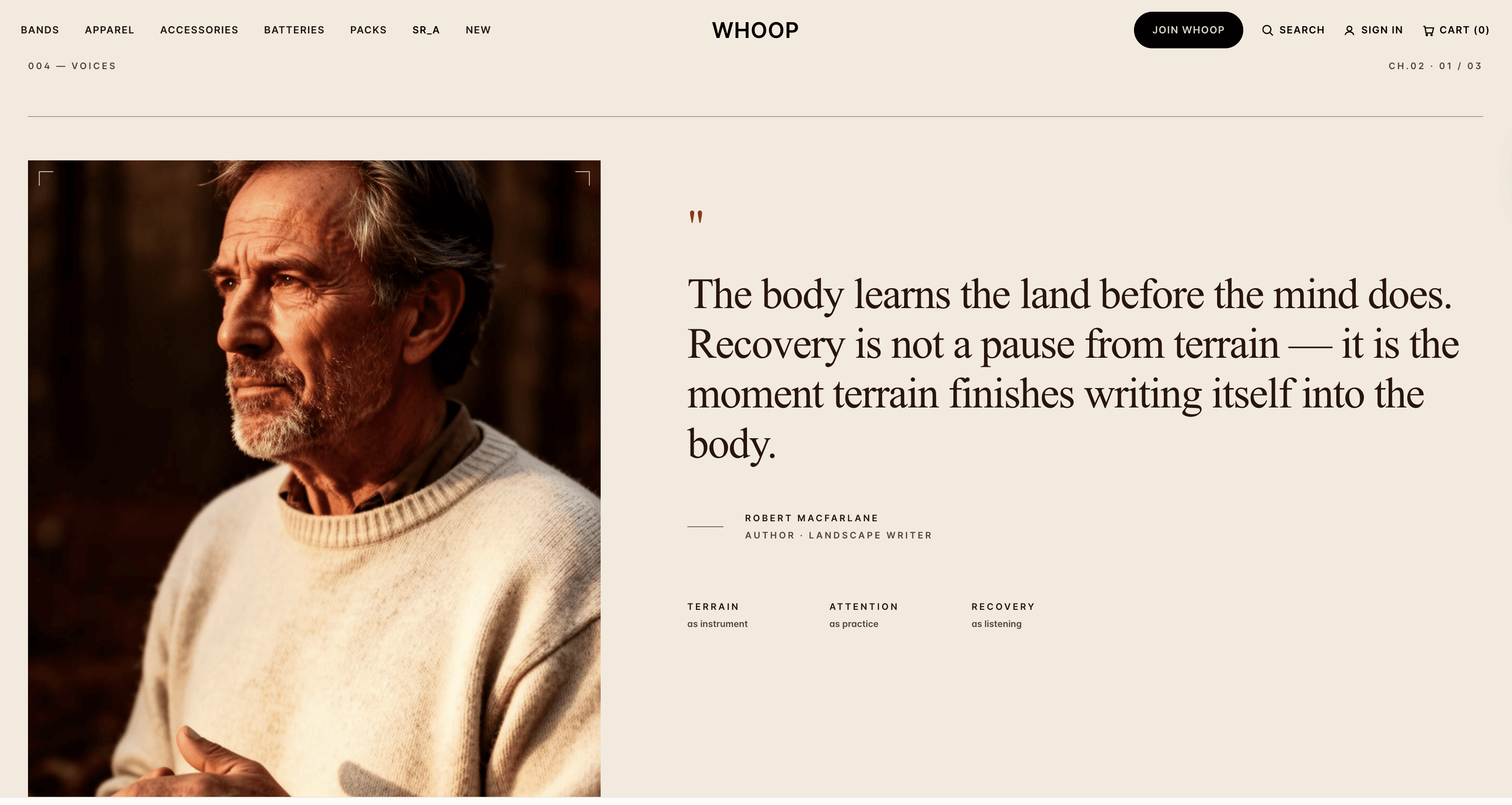
The proof that WHOOP knows where the puck is going is Project Terrain. Launched in January 2026 with Samuel Ross MBE as Global Creative Director and a multi-year partnership running through 2028, the project is structured as a three-chapter seasonal training system. Going live with six technical garments featuring discrete pockets for the WHOOP 4.0 sensors, custom SR_A bands and brand new architectural clasp tooling in brushed steel patinas, saw pieces sold out within days. This “true garment wearable design system” has been explicitly framed by Ross and WHOOP not as memorabilia but as "the way forward” (WHOOP, 2026).
The choice of Ross is not a designer-of-the-moment hire. One of many close precedents from SR_A for what Project Terrain is doing right now is the Beats × SR_A drop in 2020: Beats kept its brand surface, SR_A directed a limited collection in its own visual language, and the parent brand stayed insulated while the product sold out. Ross's design language is consistent across all of it – function over decoration, perforation as graphic system, post-Brutalist British materialism rooted in his time at A-COLD-WALL* and on industrial-design projects in Geneva. None of it is overzealous. This background enables him to isolate the core principle of WHOOP itself: a focus on function.
Project Terrain is structurally exactly what this category requires: different visual language, different audience identity, different retail, different cultural register, all running on the same hardware and corpus underneath. WHOOP's peers in the upper-right quadrant – Oura born as design-forward sleep jewelry, Eight Sleep as a smart mattress cover, Function Health as an MD-led lab membership, Levels through metabolic tracking – were positioned outside elite-athletic identity from day one. WHOOP is the only platform in the category that has to migrate the other direction, and the master brand cannot make that migration under one name without forfeiting the LeBron-Rory-NFLPA coalition that drives the existing $10.1B valuation. Female membership grew 150% YoY in 2025, women use Coach 30% more than men, and apparel is up 70% YoY (TechCrunch, 2026a). Thus, Terrain is the first surface WHOOP has built that speaks in the register it actually wants to live in.
The question Move 1 has to answer in 2026 is therefore not whether to ship a sister brand, but whether to leave Project Terrain as a finite three-chapter collaboration ending in 2028 or to graduate it into a permanent always-on brand surface. The structure already exists in athletic and luxury fashion. Adidas owns the engineering behind Y-3, but Yohji Yamamoto has directed the design for over twenty years, with its own retail, its own runway, and its own visual world running on Adidas's infrastructure underneath. The same structural play surfaces in Hims launching Hers in 2018, Apple preserving Beats as Beats after the 2014 acquisition, and Nike launching NOCTA with Drake in 2020 – a designer-led collaboration becomes a permanent brand surface that runs on the parent's infrastructure while speaking to its own audience in its own voice. Project Terrain as a collab can serve the next step as brand. WHOOP would not be building a sister brand from scratch, but institutionalizing a concept post-validation. WHOOP retains ownership while SR_A provides the creative vision, mirroring the way Yamamoto directs Y-3 inside Adidas.
Here is what the graduation looks like. First, solidify the brand and stake the URL: Project Terrain becomes Terrain, a permanent brand rather than a project, at terrain.com or its equivalent, with shop.whoop.com/sr_a redirecting cleanly so existing customers don't get lost. Second, an operating structure can be built underneath – hire a Terrain GM to run it as a separate P&L unit reporting into WHOOP, with Ross continuing as Global Creative Director under the same partnership terms. Next, shift the cadence from three limited chapters across three years to four seasonal collections per year on a permanent basis, starting after Chapter Three closes in 2028; limited drops continue inside that cadence because scarcity is part of Ross’s signature, but the brand itself runs always-on. Founding endorsers should also come from a pool outside the athletic one. Think Esther Perel, Maya Shankar, the kind of intellectual, calm, measured voices a lifestyle audience already trusts. Finally, building the technical defensibility nobody else in the category can copy would offer an exceptional edge. Use WHOOP's biometric corpus to inform the design system itself – fabric breathability calibrated against recovery scores, fit calibrated against HRV patterns, and garment ergonomics tuned against real movement data – so Terrain ends up looking like a designer brand on the surface and behaving like a data-driven product engineering system underneath, which no fashion-only competitor can match.
The strategic prize is not a second revenue line. It is whether WHOOP becomes the only platform holding both quadrants of this category as it converges, or whether the lifestyle quadrant gets ceded to Oura, Function Health, and Eight Sleep over the next decade. WHOOP becomes the only firm in the upper-right quadrant that holds the elite-athletic identity at the top and the design-led lifestyle identity beside it, on the same biometric corpus and the same Coach, the way Adidas holds Performance and Y-3 simultaneously without either brand undermining the other.
Done well, the master brand keeps winning Grand Slams and the sister brand wins the day. Project Terrain becomes the permanent brand layer instead of a three-chapter collaboration that ends in 2028. Both keep feeding the same corpus, which is what compounds.
07
The bigger bet
Wearable wellness is consolidating into a small number of recurring-revenue platforms layered on biometric or diagnostic data. The moats order along three axes: a defensible data corpus, an installed daily ritual, and an audience identity strong enough to defend a premium price. WHOOP is winning the corpus and the ritual. It is currently losing the audience-identity pillar to Oura on lifestyle and Function Health on clinical. The allocation of consumer wellness market cap goes to whichever firms own their axis hardest and compound their original audience archetype to become a high-functioning-humans platform. WHOOP holds every asset it needs to do both. The Grand Slam approval is a beautiful artifact of where it came from. The next decade isn't won at the All England Club – it's won at 7am, on a wrist that doesn't belong to an athlete, when the first thing your mother does after waking is check her score. The corpus is ready. The brand isn't yet.
08
Where this argument travels
The same audience-identity × data-depth axis cuts across every wearable wellness platform. Eight Sleep's $1.5B Series and FDA filings on apnea and menopause are the same convergence pattern from a sleep-only origin – mattress as entry vector, integrated lifestyle as destination. Oura is already in the lifestyle quadrant WHOOP is trying to reach, with peer-reviewed accuracy and a women's audience that arrived without engineering. Function Health was born in the quadrant WHOOP is racing toward – clinical-grade depth and integrated lifestyle positioning from day one. Its March acquisition of Ezra layers $499 full-body MRI onto 160+ biomarkers; the platform is already what WHOOP wants its corpus to become. Levels is doing the metabolic version of the same play, with continuous glucose monitoring as its entry vector. Therabody and Neurable face the same convergence pressure from opposite corners: Therabody has brand and audience but no data corpus under the hardware, while Neurable has proprietary neuro-signal depth but no consumer audience to receive it. Every one of these firms is being asked the same question WHOOP is being asked: how do you compound your origin audience into the integrated lifestyle platform without losing the equity that got you here? The answers will look different. The trap is the same.
About Veer
UC Berkeley Haas ’27. Recruiting full-time for product/strategy roles within consumer tech, design-forward experience and wellness, for Summer 2027. If you're at one of these firms, or know someone who is, I’d love to chat – veerbenepal.com / veerbenepal@gmail.com / LinkedIn
References